
Appearance
Tests before publishing
Agents have versions, and a change to the role can make some answers better and others worse. Tests tell you which, before people see the new version.
Writing a test
On an agent's page, Tests (editors write and run them; operators can read them). Add test:
- Prompt: what someone asks, exactly as they would.
- Contains: phrases a good answer has, one a line. Any case:
fridaymatches "Friday". - Doesn't contain: phrases it mustn't have, like "I don't know" or a competitor's name.
- Rubric: what a good answer does, in a sentence ("lists the risky changes first, in plain words"). The agent's model reads the answer and judges it against the rubric.
A test needs at least one of the three checks; otherwise every answer would pass. An agent has up to 50 tests.
Running them
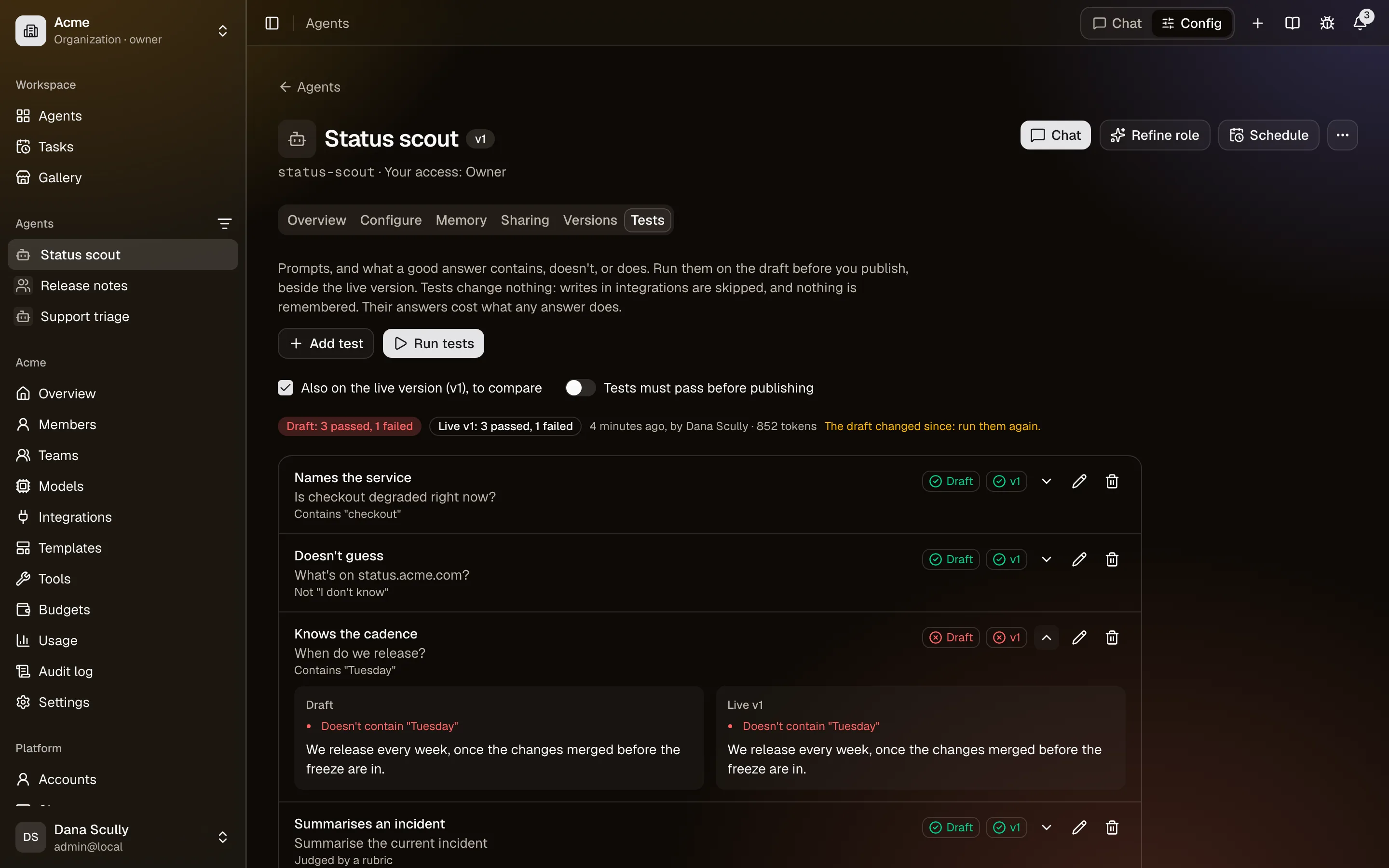
Run tests plays every test on the draft, as the agent would answer once it's published, and, with Also on the live version, on the version people use today, so you see what your change does: a test that passes live and fails on the draft is a regression.
Each test is a new conversation: it doesn't remember the others, nor anyone's conversations. The results show what passed, why the others didn't ("Doesn't contain "friday"", "Contains "I don't know"", or the rubric's verdict), and each answer, side by side. When the draft changes after a run, the results say so: run them again.
A test changes nothing
Tests run as you, with your access and connected accounts, but nothing they do lasts:
- an integration's tools that change data are skipped, and the agent is told so;
- the workspace isn't used;
- nothing is saved to memory, and no task is proposed.
Reading works as usual (web pages, searches, integrations' read tools), so answers are realistic. Each answer, and each judgement of a rubric, is a model call like any other: it counts in usage and budgets. The results show the tokens used.
Making publishing wait
Tests must pass before publishing makes Publish refuse until the tests have run on the current draft and all passed. Change the draft, and they must run again. It's a safety net, not a lock: editors can turn it off, and a role applied from the setup interview (Refine role) is published without waiting.